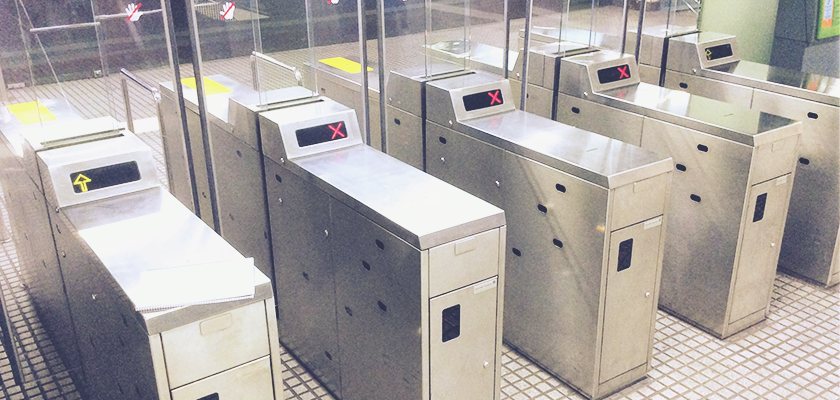
Fare gates to fight fraud in public transport in Lille
Lille (France) plans to have fare gates installed in its sixty metro stations by 2020 to reduce fare evasion
November last year, Lille’s metro (France) installed fare gates in one of its stations. Four months later, results were very positive. Ticket validation has risen sharply -up to more than 16%-, meaning 700 additional validations on average per day. In 2013, the public transport operator for the Lille Métropole, Transpole, registered a 18.4% fraud...

One in three not paying for public transport in Santiago, Chile
After closing 2017 with a 10-points fall, fraud in public transport reached 28.5% in the first term of 2018
Fare evasion rate in Transantiago continues fluctuating around elevated figures. The public transport system in Santiago de Chile closed 2016 with one its highest rate ever: 34,6%. A year later, the service managed to reduce the figure 10 points to 23,7%. However, during the first term of 2018, the rate has increased again, reaching...
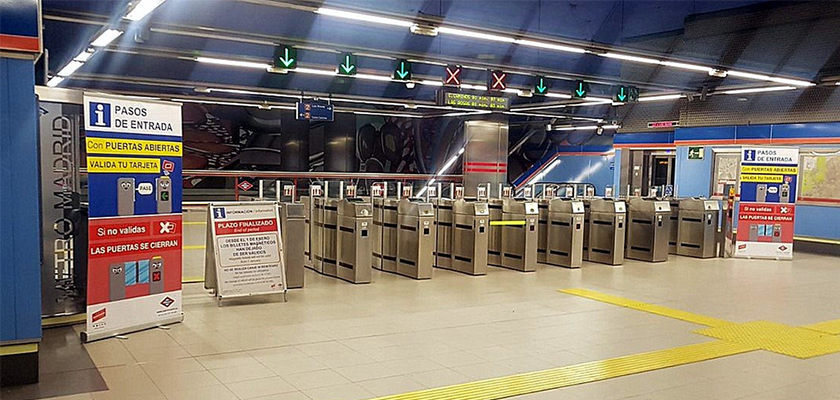
Open-door validation tests in Metro de Madrid
Fare gates remain open permanently and only close when someone does not validate their ticket
In general, fare gates in public transport do not open unless passengers validate their ticket. This practice, which intends to guarantee payment of use, is implemented in the vast majority of subway systems around the world. Metro de Madrid, however, is thinking of applying another approach already existing in Tokyo: open-door validation. The Spanish...

Paris considers offering free public transport
A toll might be implemented at the city entrance to compensate the 3 billion revenue loss
Two months ago, the Mayor of Paris, Anne Hidalgo, announced the launch of a study mission on the possibility of free public transport in Ile-de-France. Around twenty French municipalities, such as Niort (Deux-Sèvres), Compiègne (Oise) or Aubagne (Bouches-du-Rhône), have removed the pricing of its public transport. The measure is also running in Tallinn since...

Fake cards account for 40% of Barcelona’s fare evasion
People travelling without a valid ticket costed the Barcelona operator TMB 9.6 million euros in 2017
Fare evasion in public transport caused a loss of 9.6 million euros to the operator Transports Metropolitans de Barcelona (TMB) in 2017. Almost half of this cost was due to passengers sneaking into the metro with fake cards. According to the estimates of the consortium Autoritat de Transport Metropolità (ATM), around 22,200 trips were...

The psychology behind fare evasion
A recent study identifies four types of fare dodgers: Accidental, 'It’s not my fault', Calculated risk-takers and Career evaders
Fare evasion – traveling without a valid ticket in public transport- is a problem for many public transit operators around the world. It undermines the viability of public transport, causes financial losses that amount to millions yearly, and leads to feelings of unfairness and lack of safety among paying passengers. A study carried out...

Deep Learning Video Analytics for protecting public transport revenues, assets, passengers and mobility
AI Video Analytics helps to tackle fare evasion by analysing video streams in real-time
Fare evasion is the unlawful act of traveling in public transport without paying for the trip. It is a corrosive problem in many public transit systems around the world, causing feelings of unfairness and insecurity among paying passengers, and financial losses worth billions of dollars yearly. Some metro and commuter train operators deploy mass...




Trainsfare is an initiative aimed to raise awareness about the global issue of fare evasion in public transport.
We publish articles regularly on the topics of fare evasion, ticketing, public transport finance, technology, and safety and security. Our articles are sourced from mass transit operators and from trusted news sources and publications.
Trainsfare is a project managed by Awaait, a Barcelona-based company developing AI Video Analytics software.